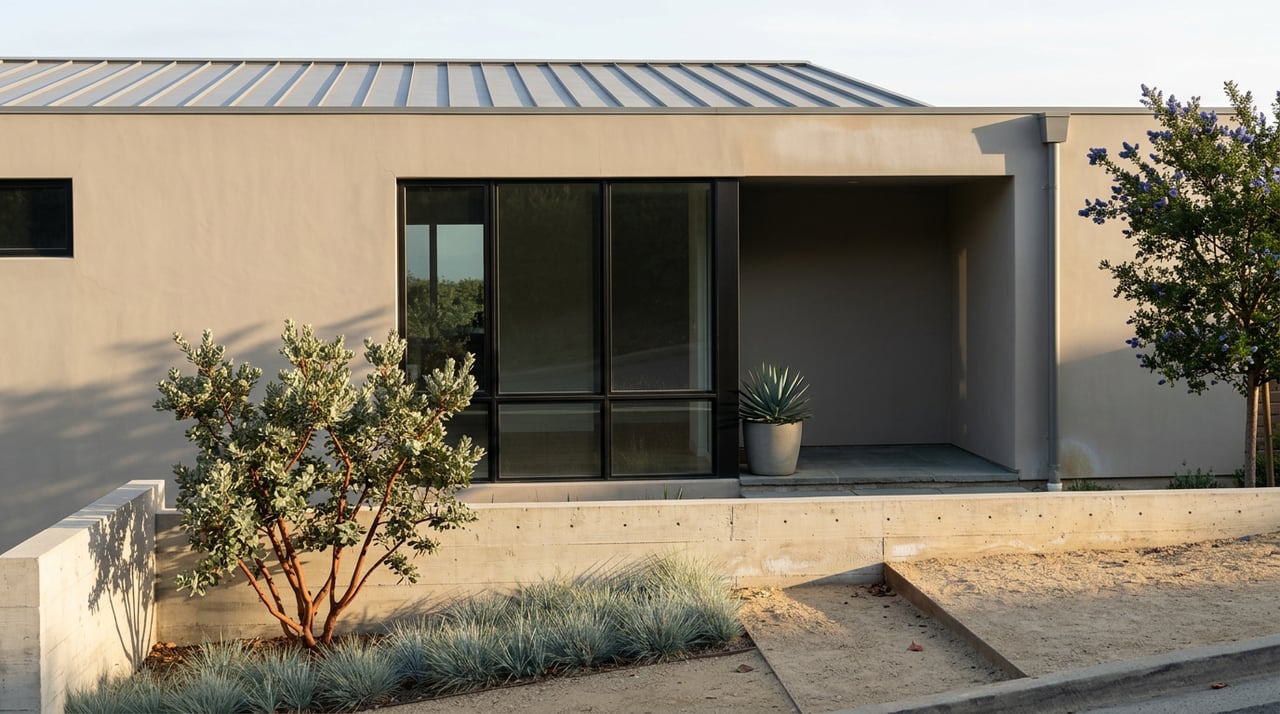
In December 2025, developers and city officials gathered on Kagawa Street to tour what Mayor Karen Bass called the first newly built home in post-fire Pacific Palisades. Thomas James Homes CEO James Mead told reporters his company expects most of its projects to finish closer to the end of 2026 and into 2027, which gives the neighborhood's commercial recovery time to catch up with the houses. That single finished address made news precisely because it was still the exception. Walk most other blocks north of Sunset and you find framing, grading equipment, and lots that have not moved in months.
For anyone trying to price a purchase or a sale in the Palisades right now, that gap between one finished house and a street full of stalled lots is the whole story. The citywide median tells you almost nothing about it.
The median is measuring the wrong thing
Redfin's figures for the three months ending April 2026 put the median sale price in Pacific Palisades at $2.8 million, down 36.4 percent from the same period a year earlier. By July 2026, portal data for the same zip code showed list prices tracking closer to $3.58 million. Those two numbers cannot both describe a simple decline, and they do not need to. Local analysts who track this market closely have pointed out that roughly 15 percent of Palisades sales happen off market and get folded into the multiple listing service only later, sometimes misclassified as single-family home sales when the parcel is actually a burned lot. A $1.5 million lot sale entered under the wrong category is enough to swing a monthly median by hundreds of thousands of dollars.
That is not a data quality footnote. It means a buyer or seller who anchors a decision to the headline median is anchoring to noise. The number that actually explains what is happening on the ground is smaller and less visible: the gap between what insurance pays and what a rebuild costs.
The gap sorting the buyer pool
According to case-study data compiled by ClaimArchitect and reported by The Real Deal in April 2026, the average shortfall between insurance payouts and realistic rebuild cost for Palisades homeowners comes to $603 per square foot, or roughly $1.5 million on a typical loss. Rebuilding in California generally runs $375 to $600 a square foot, but that climbs to $400 to $700 in high-cost markets like the Palisades, and current estimates for custom fire-resilient construction this year land at $550 to $850 a square foot before premium finishes, according to a Yahoo Finance report on a 97-year-old Palisades homeowner whose FAIR Plan policy paid roughly $38,000 toward smoke and debris remediation on a loss that ultimately cost her family about $300,000 out of pocket.
That gap is not evenly distributed. It falls hardest on owners who need financing and full insurance coverage to close, and it barely touches buyers who do not. Cash investors and builders, unconstrained by that math, picked up an estimated 40 percent of lots sold in fire-affected areas in the third quarter of 2025, the most recent period for which this breakdown has been reported. That single fact does more to explain current pricing than any median.
| Traditional financed buyer | Cash investor or builder | |
|---|---|---|
| Needs full insurance coverage to close | Yes, in most cases | Rarely a constraint |
| Sensitive to the $600/sq ft insurance gap | Directly | Indirectly, priced into offer |
| Typical timeline tolerance | Low, wants a finished home | High, 18 to 24 months or more |
| Share of recent lot purchases | Minority | Roughly 40 percent (Q3 2025) |
Sellers feel this on the other side of the table. More than 30 percent of Palisades land listings have taken a price cut since going on the market, and average sale prices are running about 10 percent below original list, even as roughly a third of lots sold through the MLS still draw multiple offers. Both things are true at once because the buyer pool has split into two groups with almost nothing in common.
Why the same street prices at $267 a foot and $720 a foot
Land in Pacific Palisades is trading anywhere from under $100 a square foot to more than $700, with a citywide average near $330. On paper that looks like an inefficient market. On the ground it reflects a handful of specific variables: slope, view, whether debris clearance is certified, whether a geotechnical report has cleared the parcel for hillside construction, and whether the lot sits in one of the Palisades Geohazard Risk Assessment Zones that trigger additional soils analysis regardless of fire damage.
Location within the burn footprint matters as much as any of those. Anthony Marguleas, a Los Angeles real estate agent, told CoStar that in the Alphabet Streets, where close to every home was lost, "you don't really want to be the first home back." A block that survived largely intact, by contrast, already feels ordinary again. That difference alone can separate two lots on comparable acreage by hundreds of dollars a square foot, which is why a buyer comparing listings by price per foot without checking clearance status and neighboring construction activity is comparing the wrong variable.
What is actually coming back, and why it matters for value
The fundamentals that made the Palisades desirable before January 2025 have not disappeared, and the visible signs of that are specific rather than abstract. Palisades Village is targeting a reopening this month, August 2026, with Erewhon returning as the anchor grocer, cafe, and tonic bar, and Blue Ribbon Sushi set to reopen with a redesigned outdoor patio and a new 14-seat omakase room, according to local reporting from Westside Current. The Genesis Invitational returned to Riviera Country Club in February 2026 after being displaced the year before. Topanga Canyon Boulevard reopened for daytime travel between Pacific Coast Highway and Grand View Drive in March 2026, restoring a 3.6-mile stretch that had been closed since the fire and the storms that followed.
None of that changes the insurance math for an individual lot. It does explain why cleared, permit-ready parcels near the village keep drawing serious interest even at elevated per-square-foot pricing. Buyers underwriting a purchase today are not just pricing a construction project. They are pricing proximity to a commercial core that is visibly, specifically reassembling itself.
Permitting has moved faster than most post-disaster rebuilds on record, which matters for anyone trying to underwrite a realistic timeline. As of the one-year anniversary of the fire in January 2026, local governments had issued permits for single-family homes and accessory dwelling units roughly three times faster than in the five years before the fire, according to CalMatters reporting on the state's disaster recovery data. Still, average wait time from application to issued permit sat at 49 days as of early January 2026, and 42 percent of that month's permits were in queue longer than that, per an analysis by Crosstown LA of Department of Building and Safety records. Faster than historical precedent is not the same as fast, and permit pace has since cooled from its 2025 peak.
What this means if you are underwriting a lot right now
A handful of questions do more work than any price-per-square-foot comparison:
- Has debris clearance been certified for this specific parcel, and can the seller produce the letter. Permits will not be issued without it.
- Does the lot sit in a designated fire hazard severity zone or a Palisades Geohazard Risk Assessment Zone, which determines whether Chapter 7A construction standards and additional soils reports apply, adding an estimated $15,000 to $80,000 or more to a build depending on scope.
- What will insurance actually cost and cover before you close, not after. Buyers in this market are increasingly treating a FAIR Plan quote as a hard transaction cost to underwrite before making an offer, not a detail to sort out afterward.
- What is the realistic timeline from permit to occupancy. Across multiple builder estimates for 2026, that range runs 18 to 24 months for most projects, longer for hillside sites requiring extensive grading review.
None of these questions show up in a median price. All of them show up in the closing costs of an actual transaction.
Quick answers for buyers and sellers weighing a Palisades lot right now
Is this a good time to buy a lot in the Palisades? It depends more on your access to cash and your time horizon than on the headline market direction. Buyers who do not need financing or full insurance coverage are operating with far more flexibility than the median suggests, and pricing on the most contested parcels, cleared lots with view potential near the village core, reflects that.
How long does a rebuild actually take in 2026? Plan for 18 to 24 months from permit issuance to occupancy on a typical single-family project, longer if the lot requires hillside grading review or falls into a geohazard assessment zone. Permit issuance itself is running faster than historical disaster recoveries, but faster than usual still means real waiting.
The math in Pacific Palisades right now rewards buyers and sellers who look past the median and into the specific numbers on a specific parcel. That is precisely the kind of analysis Hopeway Realty Group builds into every transaction, from underwriting a lot purchase to pricing a surviving home for sale. Schedule a consultation.